1300 710 863 | hello@aboutbusinessbooks.com.au

1300 710 863 | hello@aboutbusinessbooks.com.au


If you’ve ever asked your bookkeeper or accountant “how’s the business actually doing?”, the answer usually starts with one report: the P&L statement. It’s the single clearest snapshot of whether your business is making money or losing it, and understanding it puts you back in control of your own numbers instead of just trusting whatever figure shows up at tax time.
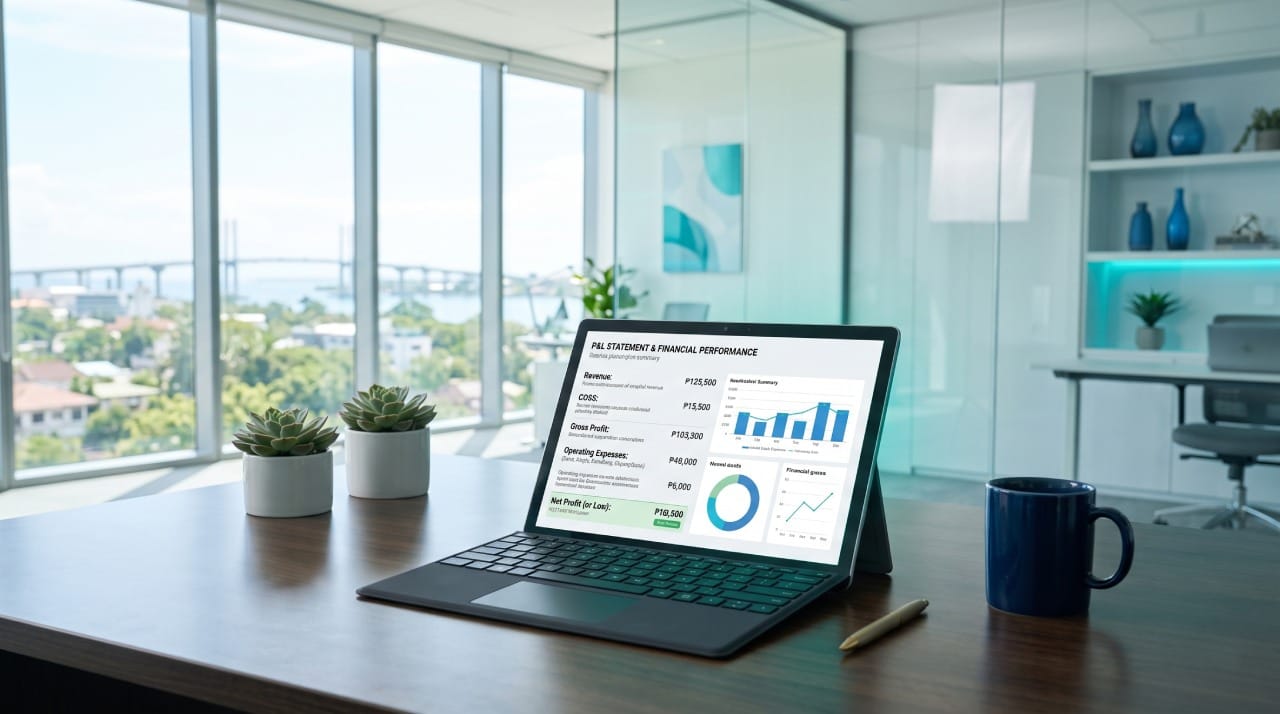
A P&L statement, short for profit and loss statement, and also called a statement of profit and loss or an income statement, lists your business’s income and expenses over a set period, then shows the result: a profit or a loss. Per business.gov.au, a profit and loss statement “lists your sales and expenses” and “tells you how much profit you’re making, or how much you’re losing,” and businesses typically complete one every month, quarter, or year.
Unlike a bank balance, which just tells you what’s in the account right now, a P&L covers a defined period and shows the full trading picture behind that number, including sales you’ve made but haven’t been paid for yet, and bills you owe but haven’t paid.
A P&L statement shows performance over a period (are you profitable this month, quarter, or year?), while a balance sheet shows your position at a single point in time (what you own and owe right now). A cash flow statement is different again, it tracks actual money moving in and out, which is why a business can show a profit on its P&L and still run into cash flow trouble if customers are slow to pay. Reviewing your P&L alongside your balance sheet and cash flow statement gives the fullest picture of how your business is really tracking.
A typical small business P&L runs through these lines, in order:
One detail that trips people up: your P&L should clearly state whether the figures are GST-inclusive or GST-exclusive. If GST is coded incorrectly in your accounting software, both your P&L and your BAS can end up unreliable, which is why it’s worth having someone check the setup rather than assuming the software got it right by default.
Monthly is the sweet spot for most small businesses, frequent enough to catch a cost blowout or a slow month before it becomes a crisis, without adding unnecessary admin. Quarterly works well if you’re already reviewing numbers alongside your BAS. Whatever the frequency, the report is only as reliable as the bookkeeping behind it, a P&L pulled from messy or uncategorised transactions will give you a wrong answer just as confidently as a right one.
A P&L statement is simply your income minus your expenses over a period, and it’s the fastest way to know if your business is genuinely profitable. Reading it alongside your balance sheet and cash flow statement gives you the complete picture, not just one slice of it. Get in touch with our Central Coast bookkeeping team if you’d like your P&L checked over or set up properly from the start.
A P&L statement lists your business’s income and expenses over a period and shows whether you made a profit or a loss. It’s sometimes called a statement of profit and loss or an income statement.
Yes. P&L statement, statement of profit and loss, and income statement all refer to the same report, the terminology just varies by country and by which software or accountant you’re working with.
Your P&L feeds directly into your tax return, since it’s where your assessable income and deductions are calculated from. The ATO doesn’t require a specific P&L format, but the figures behind your tax return need to reconcile to your business records.
Gross profit is revenue minus the direct cost of producing what you sold. Net profit is what’s left after every other operating expense, rent, wages, marketing, insurance, is also deducted.
Yes, especially with accounting software like Xero or MYOB, which can generate one automatically from your transactions. The catch is accuracy, if transactions are miscoded or GST is set up incorrectly, the report will look complete but be wrong.
Figures and guidance current as of August 2026. Always confirm your specific tax treatment with a Registered BAS Agent or the ATO.