1300 710 863 | hello@aboutbusinessbooks.com.au
1300 710 863 | hello@aboutbusinessbooks.com.au



If you’ve just started a business — or you’ve been running one for a while and you’re not totally sure your books are right — this guide is for you. No jargon, just what bookkeeping actually involves and where people usually get stuck.
Most business owners start out doing their own books, and that’s completely fine in the early days. The trouble usually starts when you hire your first employee, or your invoicing volume grows past what you can track in a spreadsheet. That’s when small mistakes — a missed BAS date, a payroll error, an unreconciled bank account — start to actually cost you money.
Here’s what you need to know.
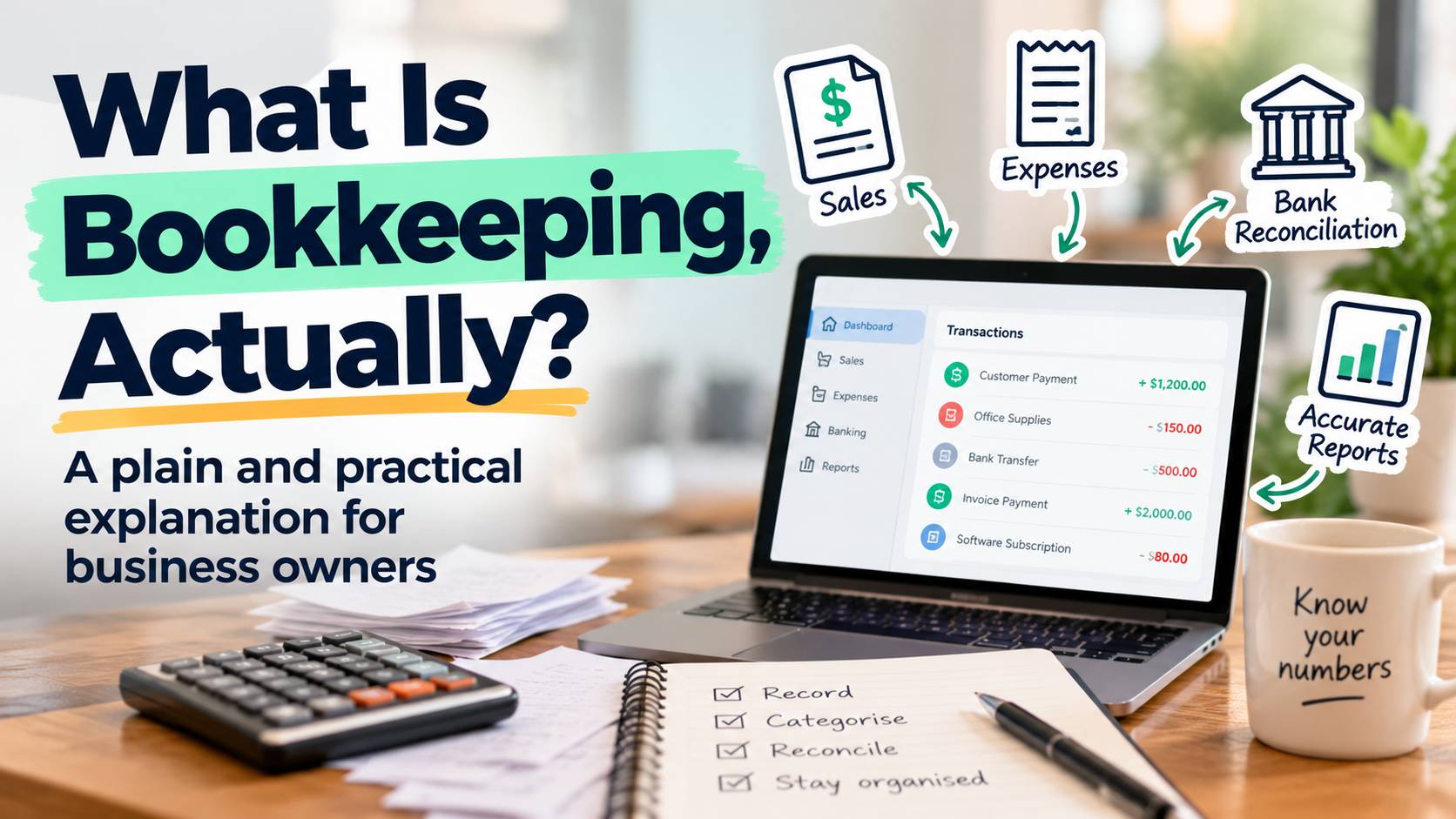
Bookkeeping isn’t just “keeping receipts.” At its core, it’s five things:
Get these five right, and you’ll always know where your business stands. Get them wrong, and problems tend to compound quietly until tax time forces them into the open.
If your business turns over $75,000 or more a year, you need to register for GST and lodge a Business Activity Statement (BAS) — usually quarterly, sometimes monthly if your turnover is higher. Your BAS reports the GST you’ve collected and paid, along with PAYG withholding if you have employees.
Missing a BAS deadline attracts penalties, and repeated late lodgement draws ATO attention you don’t want. If this feels like a moving target, a Registered BAS Agent can lodge it for you and deal with the ATO directly — see our full guide to lodging BAS.
Once you have even one employee, payroll brings real legal obligations:
None of this is meant to scare you off hiring — it just means your payroll software needs to be set up properly from day one, or you need someone checking it who knows what to look for.
Shoeboxes of receipts don’t scale, and neither does a spreadsheet you update once a month from memory. Most small businesses now use an app to photograph receipts as they happen — the data flows straight into your accounting software and matches against your bank feed automatically.
This matters for two reasons: you don’t lose legitimate tax deductions to a receipt that faded in your glovebox, and you avoid accidentally triggering Fringe Benefits Tax by mixing up genuine business costs with personal ones.
An invoice isn’t just a request for payment — it’s the thing standing between you and a cash flow problem. If your invoices go out late, or you’re not following up on overdue ones, you can end up short on cash even when your business is genuinely profitable on paper.
A few things that help:
If you’re still using a desktop program or a spreadsheet, cloud accounting software (like Xero, MYOB, or QuickBooks) is worth the switch. It gives you real-time numbers instead of last month’s, lets your bookkeeper or accountant log in without you emailing files back and forth, and connects directly to your bank feed so transactions appear automatically.
See our full comparison of cloud accounting platforms if you’re deciding which one fits your business.
There’s no fixed rule, but most business owners start looking for support when one or more of these happen:
A Registered BAS Agent can take on as much or as little as you need — from just BAS lodgement through to full payroll and bookkeeping. Take a look at our small business bookkeeping service, see our full range of services, or book a free chat to talk through where you’re at.